Wednesday, March 16, 2011

Mincha Aufrufs!

Guest post by Lisa:
A caterer friend tells me about a new trend in the community in having pre-wedding "call-ups" during Mincha on Shabbos afternoon - rather than the traditional morning affair.

There seems to be a number of theories behind this.

1) Less cost - as there is no need to feed hungry mobs who have had to put up with 2+ hours of tefilos and krias haTorah. (And even if some finger food is offered, it is far less than earier in the day.)

2) 20 minute service as compared to 2-3 hours. No more than 3 call-ups possible.

3) Less Chilul Shabbos? [As hopefully the (non-observant) guests will drive home after zeman Motzoei Shabbos.]

On the other side of the ledger, the Shul will lose out on donations for Mi Shebeirachs - as only 3 aliyos can be given.

Anyone else have any comments about this new trend?

PS. The notice states that the wedding takes place on Purim. Another first??

Meanwhile our best wishes to Emma and Jeremy on their big day


Thursday, February 24, 2011

How many Jews are there in the Northern Territory?

...Or for that matter, Tasmania?   Hardly a minyan.
But anti-Semites? Plenty!

Monday, February 21, 2011

Where to now, Tzemach Tzedek?

Sydney boy writes:

Now that a date has been set for the departure of their popular and respected Rav, what does the future hold for the Tzemach Tzedek community?

 
Do they continue to operate as an independent Shul? Will they appoint another rabbi? Do they want another rabbi? Can they afford a rabbi?

If the answer to those questions is "yes", then the next question is: "Where will they find another leader with even some of the qualities of Rav Braun?“

While Rabbi Braun was always valued and admired in Sydney, his elevation to one of the highest posts in the Chabad rabbinical world indicates how fortunate we have been to have him in our midst for the past few years. At the same time this makes the selection of a replacement an even more difficult task.

Meanwhile I am sure that everyone joins me in wishing him and his family Hatzlacha Rabba in his new position.

Friday, February 18, 2011

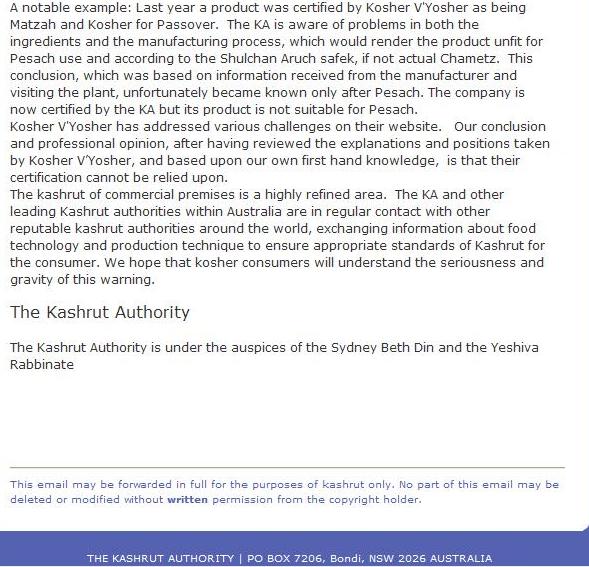
NSW KA: Protecting its turf?

Penkivil writes:

The NSW KA is again going all out to defend its turf, this time publishing, in my opinion, a libelous statement about the Kashrut organization known as Kosher VeYosher headed by Rabbi Meir Gershon Rabi. Personally I know very little about supervision issues; however I get very suspicious when the 2 majors - the KA twins - jump upon anyone who dares to raise his head and provide an alternative supervision. (If you don’t know exactly what I mean, do a “KA” search on this blog and you’ll soon get an idea.)

Did Rabbi Moshe Gutnick, prior to issuing his statement, give Rabbi Rabi the courtesy of a telephone call to discuss any misgivings? Or did he mimic his colleagues in Melbourne when they too publicly attacked Rabbi Rabi and his organisation without offering him an opportunity to respond? A certain Talmid Chacham that I respect and consult with told me that there is a minimum obligation of שמוע בין אחיכם – and indeed simple mentchlichkeit - requires one to listen to the other side before lashing out. I doubt that this happened in the case of KA v. Kosher VeYosher.

Another seemingly grave Halachic issue is the admission of KA (in their statement) that they are the current supervisors of that establishment. Can they inform us of how that happened? Who made sure that KV were kicked out so KA could get the business? Was there bad-mouthing by one Kashrus ‘business’ against another? Was there any Lashon Haa, Sheker and Rechilus involved? Is there any Halachic justification for such behaviour? And what about Chilul Hashem? What do they think that the non-Jewish proprietors think of rabbis after such an episode? To a layman like myself this sounds quite despicable and appalling. Of course I may have missed some details and if that is the case, I look forward to KA responding here or in another public notice.

Being a Sydneysider, I don’t know Rabbi Rabi. But I am an anti-monopolist and a believer in free trade. And I am convinced that if NSW Kosher consumers had more than one certifying agency, all of us would benefit.

Thursday, February 17, 2011

AJN: Still the same old nasty

We were actually hoping the AJN would've learned its lesson following its infamous and malicious front cover seeking to destroy the reputation of a hard-working and devoted rabbi - who was later absolved from all claims and accusations.
This was especially so after the previous editor was given the heave-ho and we dared to hope that his replacement would raise the AJN’s journalistic standards and move away from yellow journalism. (See also here.)

Sadly, the front page of last week's Sydney edition put paid to such dreams. The same mean approach and the same disregard shown by the newspaper in the Rabbi Engel episode is repeated.

Not the slightest concern about how their front page - which is displayed in dozens of newsagencies - will affect the thinking of the ‘friends’ of our community. And as we see from the J-Wire report, the AJN incorrectly claimed that “…Yeshiva College has refused a request by the Education Department to return $400,000 in Government funds.”

This case again shows that we cannot rely on the so-called voice of our community to show seriousness and responsibility towards its constituency. It’s about time that the JCCV and the NSW BoD took them to task and demand that they act in the interests of Australian Jewry and not to its detriment.

Government investigating Yeshiva funds

AJN February 11, 2011

YESHIVA College has refused a request by the Education Department to return $400,000 in Government funds.
The Bondi Orthodox school was awarded $925,000 by the Federal Government under the Building the Education Revolution (BER) program. That money came with a caveat that it must be used within a specified time frame.

The Association of Independent Schools of NSW (AIS) and the Department of Education, Employment and Workplace Relations (DEEWR) are now investigating whether the $400,000 already given to the school has been spent, and if so, on what.

While DEEWR has not confirmed it has asked for a refund, college principal Rebbetzin Pnina Feldman said she was not able to give the money back, even though Yeshiva has not built what it had planned to. An electricity company’s plans to build a facility close to the campus left the school¹s building intentions up in the air.

“EnergyAustralia is building a substation within 200 metres of the school, which is considered dangerous, so we can’t build what we were going to because it would be dangerous for the kids,” Rebbetzin Feldman said.

“I went to AIS and asked if we could use the money for something else, but they said no because they said the money was a stimulus for builders, not schools, so there is no point spending the money elsewhere in 2011. They said we had to give the money back or use it on that building, but I don’t want to give the money back because I have already spent a lot of it and if we have to move because of the substation, we need money to relocate.”

AIS executive director Geoff Newcombe said the investigation into Yeshiva is ongoing. “The matter is in the process of being handed over to DEEWR for further investigation, and we will continue working with the department to assist them in their inquiries,” he told The AJN.

AIS administers the grants on behalf of the Education Department to private schools in the state. Newcomb could not comment further on the specific investigation, but he did explain the circumstances under which a case could be handed over to DEEWR.

“If we conclude that the school is not satisfactorily carrying out all requirements of the agreement, we have the option of terminating the agreement we have with the school and notifying DEEWR, so that they can investigate further as they are the owner of the funds.”

A DEEWR spokesperson confirmed the investigation is currently underway. “The department is currently investigating the use of BER funding by the school, and is working closely with the Association of Independent Schools NSW to ensure it has been appropriately spent,” the spokesperson said.

And here's the J-Wire report on the same matter:

Sydney’s Yeshiva College and the Government’s $400,000

February 11, 2011 by J-Wire Staff

Rebbetzin Pnina Feldman has told J-Wire that if all negotiation attempts to use funds allocated to Sydney’s Yeshiva College under the Building the Education Revolution [BER] fail, the College will return the money to the Government.

The College had received $400,000 being the first instalment of a $925,000 grant made by the Federal Government and administered by the Association of Independent Schools of NSW. The money had been earmarked by the Government not primarily for schools…but to stimulate business for the building industry. It came with a caveat stipulating that it had be used within a specific time frame. That time has passed and the Government wants its money back.
In a prepared statement, the College’s Shalom Feldman said: “The building project was delayed due to the threat of a sub-station being built by Ernergy Australia next door which may preclude small children from being safely schooled at the site.”

College principal Rebbitzin Pnina Feldman told J-Wire that within the last few weeks Energy Australia had confirmed that the sub-station was going ahead.

The College is now attempting to negotiate with the authorities to use the funds for the seniors boys’ school. Rebbetzin Feldman said that she was pursuing every available avenue to be permitted use the funds for other building purposes. She added that she believed there were around 80 other schools being audited as to the use of the funds, saying that if all else fails the money will be returned.

A spokesman for the Department of Education, EMployment and Workplace Relations said: “As an investigation in to the use of the funds is underway, the Department can make no comment.”

Wednesday, February 16, 2011

Double-ring ceremony - prohibited by Rav Moshe Feinstein זצ''ל

Sydney Rabbi writes:
I am surprised that none of my Melbourne colleagues knows of the Tshuva by Rav Moshe Feinstein ז''ל where he clearly and unambiguously writes that it is assur for the bride to give the groom a ring under the Chuppah. They should look it up themselves in Igros Moshe, Even HaEzer vol 3, siman 18.


Tuesday, February 15, 2011

Christians adopting Jewish culture and traditions - but what about our rabbis?

Astounding article in the NY Times.

While locally we are getting reports that some of Melbourne's orthodox rabbis are permitting deviations from traditional Chuppah ceremonies, it seems that non-Jews, davka, are adopting some of our minhagim!

A little bird told us that at the recent meeting of the RCV the majority of attendees, despite agreeing that it is unacceptable, couldn't bring themselves to officially condemn one of their members who has incorporated a 'double-ring' ceremony under the Chuppah.

 
While our rabbis these days have wider, blacker hats and longer beards than those of the post-war years, they seem far less ‘allergic’ to reforms than their predecessors. Whilst our research revealed that the 'double-ring' thing was invented by the American jewellery industry in the late 19th century it has been adopted by many churches as well as Reform clergy.

Hopefully the rabbi/s permitting this type of deviation will not go all the way and use the procedure and ritual for such ceremonies composed by L. Ron Hubbard the founder of the "Church" of Scientology.

But seriously, seeing that most of the rabbis are deeply orthodox and Chabad they should seriously consider the words of one of their colleagues, Rabbi Yosf Resnick on Chabad.org, who states that such a ceremony 'cancel's out' the Halachicly required ring-giving by the groom to the bride.

To quote: "...When a woman gives a man a ring in return, they are simply exchanging articles of value. They could exchange blenders, too. Now they have just made a trade, and not effected a change of her status, to a married woman. The legal transaction implied by the groom giving the bride a ring has now been matched one for one, and thereby cancelled. Her status remains unchanged. It is as if the bride has not received anything at all, or as if she has given back the gift..."

It would be wise of our rabbis to take urgent action and heed the words of Chazal: יפה שעה אחת קודם

 
The Austins’ was not an interfaith marriage. Nor was their ceremony some sort of multicultural mashup. Both Sally and Mark are evangelical Christians, members of Oak Hills Church, a nationally known megachurch. They were using the ketubah as a way of affirming the Jewish roots of their faith.

In so doing, the Austins are part of a growing phenomenon of non-Jews incorporating the ketubah, a document with millennia-old origins and a rich artistic history, into their weddings. Mrs. Austin, in fact, first learned about the ketubah from her older sister, also an evangelical Christian, who had been married five years earlier with not only a ketubah but the Judaic wedding canopy, the huppah.

 “Embracing this Jewish tradition just brings a richness that we miss out on sometimes as Christians when we don’t know the history,” said Mrs. Austin, 28, a business manager for AT&T. “Jesus was Jewish, and we appreciate his culture, where he came from.”

Beyond its specific basis in Judaism, the ketubah represented to the Austins a broader concept of holiness, of consecration. “We wanted a permanent reminder of the covenant we made with God,” Mrs. Austin said. “We see this document superseding the marriage license of a state or a court.”

Such sentiments have been reshaping the market for ketubot (the plural in Hebrew) in the past decade. Michael Shapiro, an observant Jew from Toronto who sells artistic ketubot through the Web site ketubah.com, said he had seen the non-Jewish share of his customers rise from zero to about 10 percent. He is forming a spinoff site, artvows.com, that concentrates on non-Jewish consumers.

While evangelical Christians like the Austins make up part of that niche, Mr. Shapiro said, the concept of marital sanctity they expressed is one he hears from many gentile buyers. “There’s an idea of this being significant and lasting, a nod to something greater at work in a couple having come together,” he said in a telephone interview. “For some, it’s about God and faith. For others, it’s almost a sense of a miracle. In Jewish terms, we have the Yiddish word bashert, for ‘meant to be, intended for each other.’ ”

The decade of non-Jews discovering the ketubah coincides with three relevant social trends: the rise of Christian Zionism, the growth of interfaith marriage, and the mainstreaming of the New Age movement with its search for spirituality in multiple faith traditions. As a result, an increasing number of gentiles have taken up Judaic practices: holding a Passover Seder, eating kosher food and studying kabbalah, the Jewish mystical movement.

“A lot of these things are grass-rootsy,” said Prof. Jenna Weissman Joselit, a historian at George Washington University, who has written extensively on Jewish popular culture. “They have to do with the growing popularity of intermarriage — openness, pluralism, cultural improvisation. And for those who are more religiously literate, they add another level of authenticity or legitimacy.”

What makes the ketubah boom among non-Jews more striking is that even for Jews the present concept of a ketubah — simultaneously a work of fine art and a religious document — took centuries to develop and spread.

The earliest known version of a Jewish marriage contract dates to the fifth century B.C. in Egypt. Roughly 1,000 years later, during the Talmudic period in Palestine and Babylon, a formally codified version of the ketubah emerged.

Ketubah from 1942 in the Sydney Jewish Museum

And in its original form, far from declaring marriage as an everlasting bond, the ketubah largely served to protect a wife’s right to financial support in the event of a divorce, which under traditional Jewish law is entirely a husband’s decision. To this day, the standard Orthodox ketubah still contains language requiring a divorced man to pay his ex-wife “200 silver zuz.”

 
Sephardic Jews, though, wrote ketubot with specific provisions for each marriage. And, of more enduring aesthetic importance, they began to illustrate the documents elaborately with images and calligraphy. With the expulsion of Jews from Spain in 1492, refugees carried that artistic tradition to Italy, Germany and Holland, where the decorative ketubah began to seep into Ashkenazi culture.

 
But the style never reached into the Eastern European heartland of Jewry — which itself was the source of most of America’s Jewish immigrants — and by the mid-20th century the ketubah was back to where it had started as a document of religious law to be signed and stowed away.

All that suddenly changed with the “Jewish counterculture” of the 1960s, a movement by young Jews to participate in worship actively rather than just follow a rabbi, and to create their own prayers, liturgies, ceremonies and ritual objects, very much including ketubot.
By now, the ketubah is such a standard part of American Jewish life that even the new National Museum of American Jewish History in Philadelphia exhibits and sells them. Next month the Jewish Museum in New York will mount a major show of ketubot.

 
“You have an interest in a beautifying ritual and you have disposable income,” said Sharon Liberman Mintz of the Jewish Theological Seminary in New York, who is curating the Jewish Museum exhibit. “There’s both the wherewithal and the interest. Now you’d hang your ketubah on the wall. In the past, you’d just keep it in a safe or something like that.”

As for Sally and Mark Austin, they Googled their way to ketubah.com, selected a version with the image of a flowing river, and chose one of several texts from the Reform Jewish movement. After their wedding day, they hung it over their bed.

 
“One of the characteristics of a covenant,” as Mrs. Austin put it, “is a tangible sign. And this piece of paper, this beautiful piece of art, is the sign of our covenant.”

Wednesday, February 9, 2011

What Parsha did they lein in your Shul last Shabbos?

The Haaretz apparently thinks it was parshas "Blah Blah"
(Hat tip BeChadrei Charedim")

Tuesday, February 8, 2011

Spodiks for Cairo craniums?

These photographs depicting some unbelievable "protective" head-gear used by the revolting Egyptians in Cairo gave us the idea to launch an appeal to supply them with unused and unwanted Shtreimels and Spodiks. It's the elast we can do for our cousins.
After all, they wouldn’t offer any less protection than a bread-roll, discarded plastic soft-drink bottles, or even a cardboard carton. And no doubt that the 'spiritual' effect of Chassidish fur will also do them some good.

The chap sporting the concrete slab atop his skull probably has a better chance against flying rocks and shrapnel than his mate with his nut in the plastic waste-paper basket. Though appending it only with a scarf may be challenging.


So let's go for it, chaps...


Sunday, January 30, 2011

"Chabad of CBD" opportunity

Here’s an opening for the warriors in the battle for the title of Chabad shliach in the CBD.

Seeing that each side is backed by a well-heeled BRW rich-lister – Joe Gutnick v. Nathan Werdiger, why doesn’t one of them invest in the original Melbourne Shul and turn it into a REAL “Chabad of CBD”?
The senior Werdigers

Joseph Gutnick with the Legend sponsored Mount Isa AFL Team
 (Note to Colliers: If our suggestion is taken up, AJN Watch would appreciate a spotter’s fee. Thanks.)


Message to Solomon Lew: Give the average Aussie a go.

Is there any way to describe Solly’s letter in the AJN other than pure spin and chutzpah?
Observing him and his partners in the “Retail Coalition” trying to impose GST on imported goods valued under $1000 is an unsightly and greedy attack on Australian families who have found a way to save substantial amounts on by purchasing products available from on-line businesses.

What Lew doesn’t realise is that while being GST-free is helpful, the main reason we are buying over the web is because prices are far, far lower than Solly and his friends are charging us in their stores. In fact the GST component often doesn’t even cover the shipping costs involved. What really makes us go online are the actual prices of the goods purchased – often 30-40% below the local cost.
From Herald-Sun

Your crocodile tears about the threat to Australian jobs should have been shed when big retailers were devastating most of the small shops and shopping strips all over the country.

And do you think that we have forgotten how you and the others who do nearly all their buying overseas have totally ruined the Australian clothing and footwear manufacturing industries. How much concern was there about those Aussie jobs?

One would’ve thought that after Gerry Harvey backed out of this crusade your Yiddishe kop would also have also realised that you and your companies aren’t gaining any friends by continuing this campaign.

And it seems that even Dr Seuss has issues with Sol:
and there's even a Hebrew version...

POST SCRIPT:
Here's an item in today's Sunday Age "Heckler" column:
We wonder what this nephew thinks about Uncle Sol's idea to charge GST for on-line purchases?

Tuesday, January 25, 2011

How will our kids afford a home?

Posted by a very concerned parent:


The price of housing in both Melbourne and Sydney is totally out of hand and getting worse by the week. How will our children ever be able to afford even the most basic accommodation? Here's an article published in yesterday's Age:

Melbourne housing now 'severely unaffordable'
Chris Zappone   January 24, 2011
Australian homes among least affordable


Sky-high house prices in some of our biggest cities have made Australia one of the least affordable places to live in the world. Melbourne has scored near the bottom of an international ranking of housing affordability, stoking fears runaway house prices have made Australia a less equitable country.

Update The Demographia International Housing Affordability Survey, which ranked 325 markets by affordability, listed Melbourne as the world's 321st most affordable city, more reasonably priced than only Sydney and a handful of other locations.

London is more affordable than Geelong.
The ratio of house prices to median yearly household income was 9 in Melbourne, versus 9.6 in Sydney - the second least affordable city in the world, in spot number 324, according to data produced by the US-New Zealand anti-regulation group Demographia in a survey of six English-speaking nations and Hong Kong.

The group put the median Melbourne house price at $565,000 with the median household income at $63,100. Hong Kong came in last at number 325, with an income-house price ratio of 11.4, while Saginaw, in Michigan ranked No. 1, with a multiple of 1.6. Demographia considers markets with a median multiple of 3 or less "affordable", while those with 5.1 or more are considered "severely unaffordable". Australia's major markets were all considered "severely unaffordable''.

US-based geographer and author Joel Kotkin said that even after the housing bubble implosion in the US and Britain beginning in 2008, the ratio of home prices to incomes has grown in major cities such as Los Angeles, San Francisco, Boston, London, Toronto and Vancouver. "Perhaps most remarkable has been the shift in Australia, once the exemplar of modestly priced, high-quality, middle-class housing, to now the most unaffordable housing market in the English-speaking world," he said. "The real issue is affordability and Australia has gone from a middle-class paradise in that regard into a more stratified society - just as we find in Britain and parts of the US." SNIPPED
 House prices plateaued in mid-2010, amid interest rate rises and a weaker pace of sales. The national city dwelling price fell 0.2 per cent in November, to $466,000, according to RP Data-Rismark information. Six in 10 Australians live in major cities. The third quarter 2010 rankings were compiled from national housing reports and estimates drawn from census data on incomes, with calculations made in local currency.

Swelling cities
Separately, a report from the Department of Immigration and Citizenship calculates that if 260,000 migrants come to Australia per year, both Sydney and Melbourne will need to expand by 430,000 hectares, or 4300 kilometers by 2060. “Expansion of urban areas raises issues such as likely increases in traffic congestion, city (air) pollution, and competition for land as a resource,” the report concluded. “The latter is an important issue since peripheral land of a number of capital cities has been relatively productive agriculture land, which can supply fresh food to the local area with lower freight requirements.”

The report on the physical impact of immigration was prepared by Flinders University and the Commonwealth Scientific and Industrial Research Organisation Sustainable Ecosystems Department of Immigration and Citizenship.

'Severely unaffordable'
The Demographia report showed Australian cities shared the mantle of “severely unaffordable” with American, Canadian, British and New Zealand cities. Demographia listed Melbourne as the world's 321st most affordable city, more reasonably priced than only Sydney, which came in at 325th, and a handful of other locations. The survey found that the ratio of house prices to median annual household income was 9.6 in Sydney. It put the median house price at $634,300 and median income $66,200.SNIPPED
Sydney-based real estate research and investment group Rismark believes Australian homes will become more affordable through 2011, as incomes remain strong and house prices flatten out. "As Australia's business investment and export boom drives strong household income growth at the same time as interest rates keep dwelling prices in check, we are likely to see a substantial improvement in residential real estate valuations," said Rismark joint managing director Christopher Joye. SNIPPED

If the situation is so dire for the general popluation, al achas kamoh vekamoh for obersernant Jews who are so severely limited to where they can live?

Whatever happened to the much ballyhooed plans for a “shtetel” in Melton and/or Caroline Springs - which the AJN reported on some time ago? And what about all those Adassniks who were considering a move to Frankston? (Actually we hear that a number [of non-Adassniks] have already moved there or are in the process of doing so.)

And what happened to that magnificent initiative of the late Mr Izzy Herzog ע''ה to construct affordable apartments on the corner of Hotham Street and Glen Eira Road? That large piece of land still looks like a moonscape with nary a hut on it. Mr Herzog’s idea of building 20-25 flats there - exclusively to local frum families - would make a sizeable dent in the demand – at least for a while.

AJN Watch considers rocketing home prices as one of the most serious issues facing our community, one that needs to be taken up immediately by the Shuls and organisations. We cannot continue to tolerate a situation where families with 5 - and even more - children are cramped into 2 bedroom flats. And even these do not come cheap. Weekly rental of over $400 is quite common. And if you want to buy one, have over $400,000 ready.

It’s over to you - the leaders of  Melbourne and Sydney Kehillos. For the sake of your and our children and grandchildren.


Monday, January 24, 2011

Amazing grapes: "Without fear of Shmitta and foreskin..."

Forwarded from the SBA list:

Someone has emailed me a copy of a label for a brand of Israeli grape juice “Hamalug”. It carries the Hechsherim of both Agudas Yisroel and Rabbanut Jerusalem.
The (English) ingredients list includes the following gems:

“preservatives according to standards”,
“underwent pasteurization”,
“blessed by Borei Pri Hagefen”,
“Accepted as well by Maran Bet Yosef”,
“JNF (!?) 88 calories at 100ml”,
“Terumah (priestly tithe on produce)"
“This Tirosh is bottled in a new bottle and cooked”

But the gold medal must go to.....
"Without fear of Shmitta and foreskin” (!!!).

(For those who didn't catch on, that last attribute was their (or Google's) translation of נקי מחשש שמיטה וערלה (“naki mechashash shemittah v’orloh”)…

Friday, January 21, 2011

Rabbis 'on the wagon': What next?

A whole month without Mashkeh! How are they going to survive?
After all, many of them have congregants who MUST be driving them to drink...

And lucky that this year there are 2 Adars - otherwise Purim would have messed up this Febfast shtick.

Sunday, January 9, 2011

Where are the Chabad rabbis?

Posted by "Baby-boomer Lubavitcher":

The youngsters in our midst (and by that I mean anyone under 40-45) would hardly remember or maybe even know of the "world war" that the Rebbe waged against the various governments of Israel - demanding that they put into place legislation which ensured "Giyur keHalacha", ie, that all conversions recognised by the Rabbanut and therefore the state must be according to the dinim of the Shulchan Aruch.

It would be well worthwhile for those "youngsters" to do some research to learn how our holy rebbe shook heaven and earth to try and force the Israeli politicians to introduce this.

Sadly he failed, resulting in – amongst other scandals - the assimilation of half a million goyim from the former Soviet Union who are today recognized as Jewish citizens of Israel.

The Israeli government has recently passed laws approving 'quickie' conversions to be performed by the Army rabbinate in a manner which is not acceptable as Halachic to the rest of the Rabbinate in Israel.

The leading Torah sages there have issued proclamations attacking this new move and no doubt we will be hearing much more about this in the coming days.
I am however puzzled about the absence of similar denunciations by the Chabad rabbis both in Israel and the Diaspora. They know as well as I do how close this issue was to the Rebbe's heart.

Shouldn't they be in the forefront of this latest campaign?

Yelamdenu Raboseinu, why are you quiet? Why aren't you involved in the holy battle for the integrity of our Torah and the honor of our Rebbe?

As I recall, last time, it was Reb Arel S. leading the troops here in Melbourne - gathering hundreds of signatures demanding Giyur keHalacha. Maybe it's time for a repeat performance?

PS. On a number of local blogs there has been - for the past weeks - debate and argument about who is and who isn't a "Shliach" and a "Head Shliach". My view is that anyone who doesn't publicly support, shturem and undertake Peulos for the Rebbe's inyonim has no right to make any claim for that title.